
Germany Streetwear Manufacturer | Trusted Ultimate 50-MOQ 2026
08/14/2026
Custom Twill Cap Manufacturer | Trusted Ultimate 50-MOQ 2026
08/16/2026Netherlands Streetwear Manufacturer: The 2026 Production Guide for Dutch Labels
TL;DR: TaiDe is a Netherlands streetwear manufacturer producing at a 50-piece MOQ from our Dongguan factory, shipping to Rotterdam in 30-34 days with Dutch tall fit blocks, ISO 4920 water-repellency data and packaging weights formatted for Afvalfonds and UPV Textiel reporting.
The Netherlands punches far above its population in streetwear. Patta, Daily Paper, Filling Pieces, Olaf and The New Originals all built international followings from a country of 18 million people, and they did it with a specific product logic that most factories get wrong on the first sample. A Netherlands streetwear manufacturer has to solve for two things nobody else in Europe demands at the same intensity: bodies that are taller than any other market on earth, and garments that survive a daily bike commute in horizontal rain. TaiDe Streetwear Manufacturing has produced for European brands from Dongguan since 2006, and both of those requirements are now baked into our default Dutch spec.

Why Fit Blocks Decide Whether a Netherlands Streetwear Manufacturer Gets Reordered
Dutch men average around 1.83m and Dutch women around 1.70m, the tallest national averages recorded anywhere. A hoodie cut on a standard EU block reaches a Dutch customer with sleeves that stop short of the wrist bone and a body hem that rides above the belt when the arms go up. It photographs fine and it sells once.
Our Dutch block adds 3cm to hoodie body length, 2cm to sleeve length and 1.5cm to the armhole drop against our base EU block, while holding chest width unchanged so the oversized silhouette does not turn into a boxy one. We grade S-XXL as standard and XXXL on request, and any Netherlands streetwear manufacturer quoting you a “European fit” without asking about a tall grade has not worked in this market. The base oversized construction it builds on is documented on our oversized hoodie production page.

Bike-Proof Construction: What a Netherlands Streetwear Manufacturer Builds Differently
Around a quarter of all trips in the Netherlands are made by bicycle, and in Amsterdam and Utrecht it is closer to half. That changes the garment brief. Shoulder seams take repeated load from a backpack, cuffs get soaked before anything else, and the back hem is the first area to show abrasion against a saddle.
Our default Dutch AW spec responds to all three: a PFC-free C0 durable water repellent finish tested to ISO 4920 spray rating 4, reinforced shoulder seams at 14 stitches per inch with a taped inner shoulder, 42-stitch bartacks at pocket corners tested to 280N, and a reflective print or heat-transfer detail on the sleeve or back yoke as a no-cost option. Print methods for reflective and standard graphics are covered on the mens print programme hub, and outerwear equivalents sit under the mens outerwear programme hub and the coach jacket page.

UPV Textiel and Afvalfonds: the Dutch Compliance Stack
The Netherlands runs two separate extended producer responsibility obligations that catch streetwear brands, and they are frequently confused with each other.
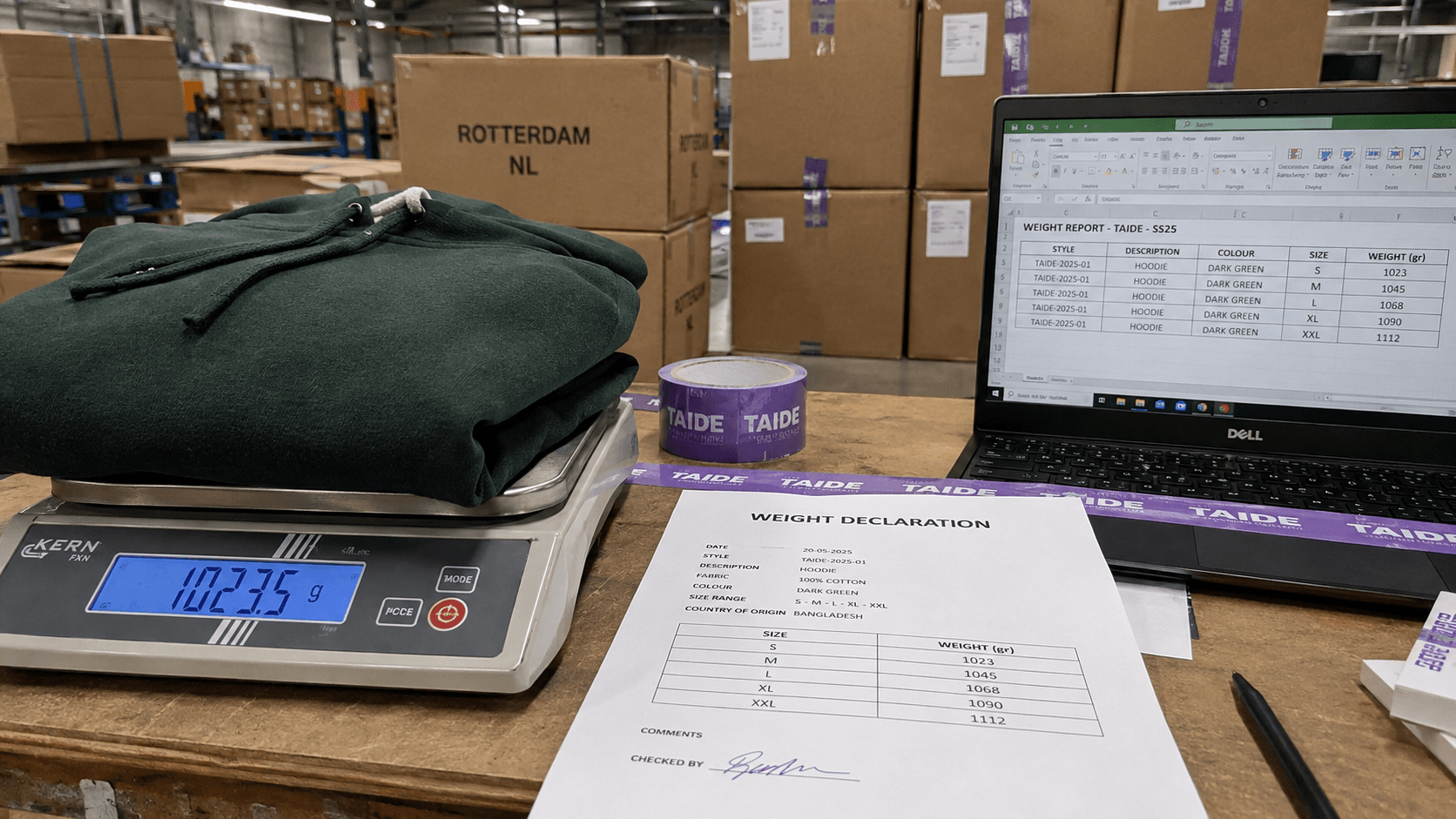
UPV Textiel is the textile EPR scheme, in force since 2023. Anyone placing textile products on the Dutch market must register and report the tonnage of garments placed, and pay a fee that scales with weight and with recycled content. Reporting is by product weight, which means a brand needs garment weights per style before it can file.
Afvalfonds Verpakkingen is the separate packaging scheme, covering polybags, hangtags, cartons and tape. It has its own reporting threshold and its own tariff table.
| Obligation | Scope | Reported unit | What TaiDe supplies |
|---|---|---|---|
| UPV Textiel | Garments placed on the Dutch market | Kilograms of textile | Net garment weight per style and per size |
| Afvalfonds Verpakkingen | Polybag, hangtag, carton, tape | Kilograms per material type | Three-way packaging weight split per shipment |
| EU Reg. 1007/2011 | Fibre composition labelling | Per garment label | Dutch and English two-panel label |
| REACH Annex XVII | Azo dyes, SVHC, restricted substances | Per shipment declaration | Declaration issued with every shipment |
| Care labelling | GINETEX symbol sequence | Per garment label | Fixed five-symbol sequence sewn in |
Both filings need factory data, not warehouse guesswork. A Netherlands streetwear manufacturer that ships without per-style garment weights is handing you a weighing exercise before you can file. Our chemical and social audit position is documented on the OEKO-TEX certified streetwear page, the GRS certified streetwear page and the BSCI certified streetwear page. Certificates can be verified independently through the OEKO-TEX label check tool, and EU-wide restricted substance rules are published by the European Commission.
Rotterdam, Article 23 and the Cash-Flow Advantage of a Dutch Import Route
Rotterdam is the largest port in Europe and the reason many brands from other EU countries import through the Netherlands rather than their home port. The mechanism is the Article 23 licence, which lets an importer defer import VAT to the periodic VAT return instead of paying it at the border and reclaiming it later. For a brand importing €80,000 of goods, that is roughly €16,800 of cash that never leaves the account.
| Line item | Per hoodie (EUR) | Notes |
|---|---|---|
| FOB Shenzhen | 19.10 | 480gsm fleece, C0 DWR, reflective sleeve print |
| Sea freight + insurance | 1.05 | LCL, Shenzhen to Rotterdam |
| Duty at 12% | 2.42 | EU Common Customs Tariff on CIF |
| Clearance + inland | 0.40 | Amortised, Rotterdam to Amsterdam |
| Landed cost | 22.97 | Import BTW deferred under Article 23 |
Transit is 30-34 days Shenzhen to Rotterdam, which is typically two to four days faster than the Hamburg routing used by our German accounts — a comparison set out in the Germany streetwear manufacturing guide. Production is 20-25 days for 50-500 pieces, so a first order runs 53-62 days door to door and repeats compress to 40-46 days.
Fabric Specs a Netherlands Streetwear Manufacturer Should Be Quoting
| Product | Dutch spec | Test standard |
|---|---|---|
| Heavyweight hoodie | 480gsm loop-back fleece, 80/20, C0 DWR | ISO 6330 wash, under 3% shrinkage |
| Graphic tee | 240gsm single jersey, combed ring-spun | ISO 105-C06 colour fastness, grade 4-5 |
| Coach jacket | 320gsm cotton-nylon, PFC-free DWR | ISO 4920 spray rating 4 |
| Cargo pants | 340gsm 3/1 cotton twill, tall grade | EN ISO 12947 Martindale 30,000 rubs |
| Reflective detailing | Heat-transfer retroreflective film | EN ISO 20471 reflectivity reference |
Construction detail for each sits on the graphic tee page and the cargo pants page. Buyers comparing European market requirements side by side should also read the UK streetwear manufacturing guide and the USA streetwear manufacturing guide, since test methods diverge between ISO and AATCC systems.

Starting a 50-Piece Programme With a Netherlands Streetwear Manufacturer
Send a tech pack, a reference garment or a photo with a target price. You receive a costed FOB quotation inside 48 hours, a sample in 7-10 days with the fee credited against bulk, and a 20-25 day production window on a 30% deposit. Minimum is 50 pieces per style per colourway, structured as described on our 50-piece MOQ production page. Market context for the wider European streetwear cycle is tracked in Business of Fashion reports.
Frequently Asked Questions
What is the minimum order for a Netherlands streetwear manufacturer?
Fifty pieces per style per colourway. The 50-piece MOQ applies to hoodies, tees, coach jackets and cargo pants alike, and has been our standard since 2006.
What is the difference between UPV Textiel and Afvalfonds Verpakkingen?
UPV Textiel covers the garments themselves and is reported in kilograms of textile placed on the Dutch market. Afvalfonds Verpakkingen covers the packaging around them — polybags, hangtags, cartons and tape. They are separate registrations with separate tariffs, and both need weight data from the factory.
Do Dutch sizes really need a different fit block?
Yes. Dutch averages are the tallest recorded nationally, so our Dutch block adds 3cm to body length, 2cm to sleeve length and 1.5cm to armhole drop against the base EU block, with chest width held constant to preserve the oversized silhouette.
How long does shipping from China to the Netherlands take?
Thirty to thirty-four days by sea to Rotterdam, plus 20-25 days of production for a first order. Rotterdam typically clears two to four days faster than the Hamburg routing.
If I import through Rotterdam but sell in Belgium and Germany, does that actually save me anything?
It usually does, and it is one of the most common reasons non-Dutch brands use us as their Netherlands streetwear manufacturer. An Article 23 licence defers the import BTW to your periodic return instead of paying it at the border, so on an €80,000 shipment you keep roughly €16,800 in working capital that would otherwise sit with customs for weeks. You still owe VAT in the country of final sale, so this is a cash-flow win rather than a tax saving — but for a brand funding its own production runs, cash flow is usually the binding constraint.
Ready to spec an AW26 Dutch drop? Send your tech pack or reference photos and we will return a costed quotation with a Rotterdam landed-cost estimate inside 48 hours.